The Signal Fabric™
The real-time nervous system of your environment.
A continuously running, ultra-low-latency layer that observes live network activity, extracts micro-behaviors, and fuses them into high-fidelity security signals — before logs, alerts, or detections exist.
Signal Fabric™ is a Global Threat Intel product. Streaming Defense is built on it, and Global Threat Intel also offers it on its own for live operational data beyond cybersecurity.
How it works
Four continuous motions.
- 01
Listen to the network
Tap live network flows — no agents, no payload inspection — capturing who is talking to whom, how often, and in what patterns.
- 02
Extract micro-signals
Identify subtle behavioral clues: timing irregularities, burst patterns, identity-linked anomalies, lateral-movement precursors, encrypted-traffic fingerprints.
- 03
Weave them together
Correlate micro-signals across identities, devices, workloads, and time to form a live behavioral map of the environment.
- 04
Emit decision-grade signals
When meaningful behavior emerges — recon, credential misuse, ransomware staging — emit a structured, explainable signal to the decision engine.
Why it matters
Earlier. Cleaner. Richer.
Earlier than SIEM/XDR
Signals appear before logs or alerts exist. You stop the attacker chain at the earliest observable behavior.
Cleaner than NDR
No payload decryption, no packet capture bloat — pure behavior, fused across identity + network + time.
Richer than identity tools
Identity, network, and behavior fused into one decision-grade signal — with a full context trail.
If your security stack is the brain, the Signal Fabric™ is the nervous system — always sensing, always interpreting, always ready to act.
Why Signal Fabric™
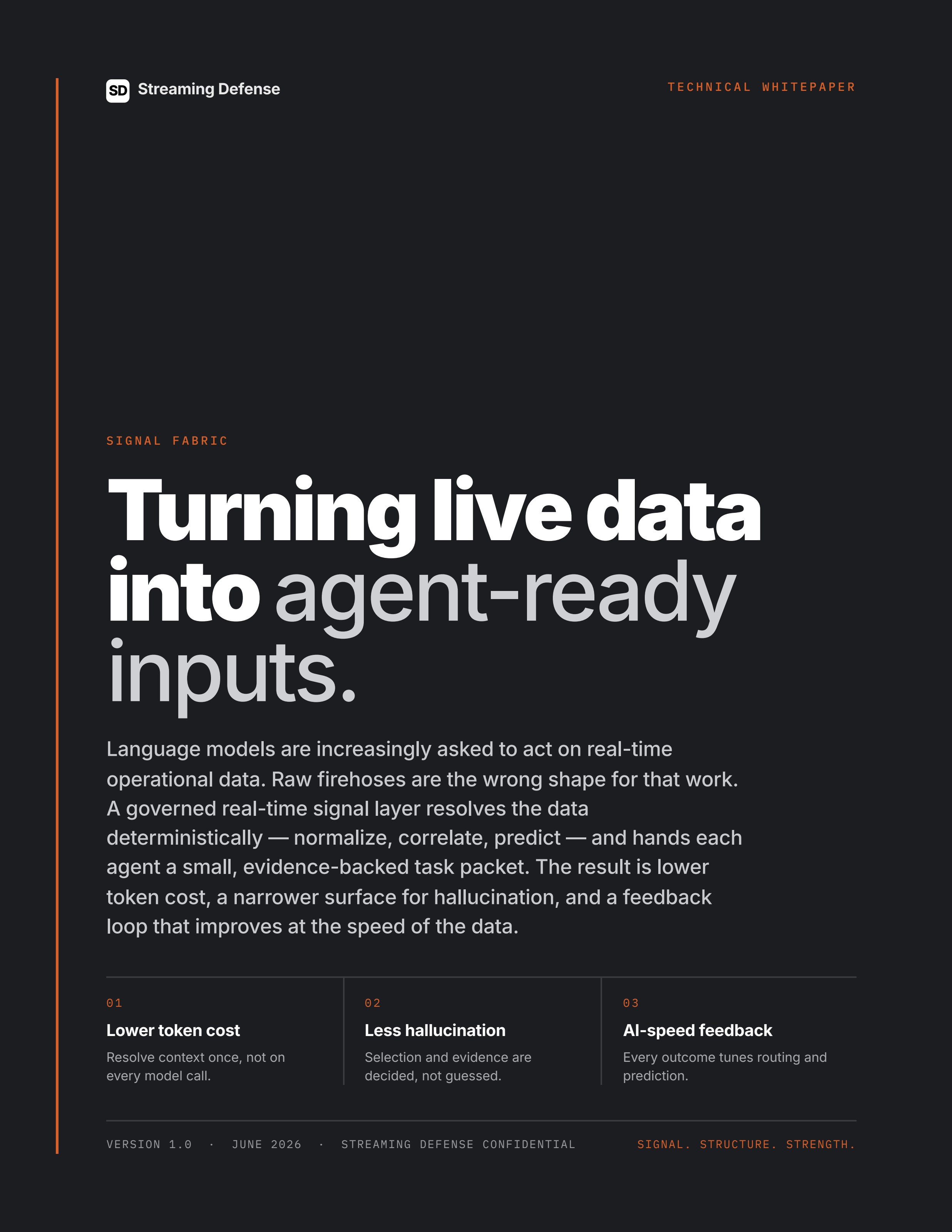
Turning live data into agent-ready inputs.
Language models are increasingly asked to act on real-time operational data. Raw firehoses are the wrong shape for that work. A governed real-time signal layer resolves the data deterministically — normalize, correlate, predict — and hands each agent a small, evidence-backed task packet. The result is lower token cost, a narrower surface for hallucination, and a feedback loop that improves at the speed of the data.
Lower token cost
Resolve context once, not on every model call.
Less hallucination
Selection and evidence are decided, not guessed.
AI-speed feedback
Every outcome tunes routing and prediction.